

Written by the editor.
Introduction
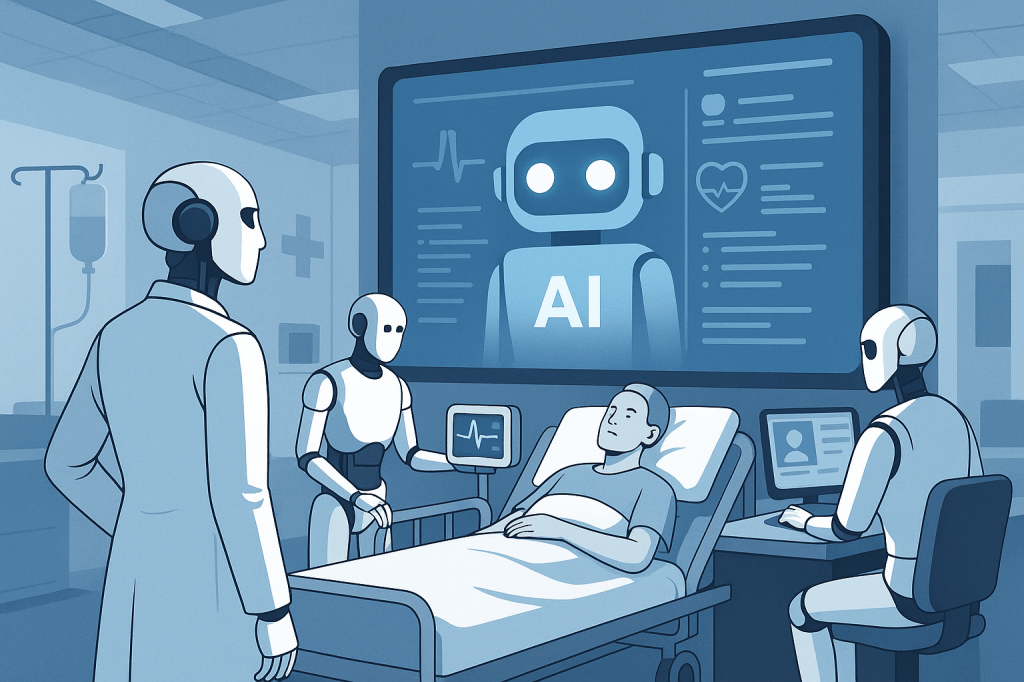
The healthcare sector is undergoing a radical transformation driven by artificial intelligence (AI). AI-powered hospitals represent a paradigm shift in medical care, offering unprecedented levels of efficiency, accuracy, and patient-centered treatment. According to a 2023 report by Accenture, AI applications in healthcare could save the U.S. healthcare economy $150 billion annually by 2026 (Davenport & Kalakota, 2019). By integrating AI into diagnostics, surgical procedures, patient monitoring, and administrative workflows, hospitals are achieving remarkable improvements in outcomes while reducing costs. A prime example is the AI-powered hospital in China discussed by Amiras (2024), which demonstrates the practical implementation of these technologies. While challenges remain regarding ethics, regulation, and human oversight, the potential benefits of AI-driven healthcare are too significant to ignore. This essay explores the current applications, benefits, challenges, and future prospects of AI-run hospitals.
The Role of AI in Modern Hospitals
1. Diagnostics and Medical Imaging
AI has demonstrated remarkable capabilities in medical imaging analysis. Deep learning algorithms can detect anomalies in X-rays, CT scans, and MRIs with accuracy rivaling or exceeding human radiologists (Esteva et al., 2021). For instance:
- Google’s DeepMind Health developed an AI system that detects over 50 eye diseases with 94% accuracy (De Fauw et al., 2018).
- The FDA-approved IDx-DR system autonomously diagnoses diabetic retinopathy without physician input (Abramoff et al., 2018).
These advancements significantly reduce diagnostic errors and enable earlier disease detection.
2. Robotic Surgery and AI-Assisted Procedures
AI-powered robotic systems are revolutionizing surgical precision:
- The da Vinci Surgical System allows for minimally invasive procedures with enhanced 3D visualization and tremor filtration (Lanfranco et al., 2004).
- Smart Tissue Autonomous Robot (STAR) performed soft tissue surgery better than human surgeons in preclinical trials (Shademan et al., 2016).
- AI integration provides real-time surgical guidance by analyzing patient vitals and anatomical data during operations (Moustris et al., 2011).
3. Case Study: AI-Powered Hospital in China
Amiras (2024) highlights a groundbreaking AI-driven hospital in China that exemplifies this technological integration:
- Smart Diagnosis Systems: AI analyzes electronic health records (EHRs) and imaging to assist physicians, reducing diagnostic time by 30%.
- Robot-Assisted Patient Care: Autonomous robots handle medication delivery, disinfection, and basic patient interactions.
- Predictive Patient Monitoring: Machine learning models predict clinical deterioration 6-12 hours before critical events occur.
This model demonstrates how AI can enhance efficiency while maintaining quality care.
4. Predictive Analytics and Personalized Medicine
AI enables precision medicine through:
- IBM Watson for Oncology provides evidence-based treatment recommendations by analyzing medical literature and patient records (Somashekhar et al., 2018).
- Deep learning models predict sepsis risk up to 48 hours in advance (Shimabukuro et al., 2017).
- AI-driven genomic analysis tailors cancer therapies to individual patients (Kurzrock & Stewart, 2017).
5. Administrative Automation
AI streamlines hospital operations through:
- Natural language processing (NLP) chatbots for patient triage (e.g., Babylon Health).
- AI-powered scheduling systems that optimize staff allocation (Davenport et al., 2020).
- Automated billing and claims processing, reducing administrative costs by 20-30% (Jiang et al., 2017).
Benefits of AI-Run Hospitals
- Improved Diagnostic Accuracy
- AI reduces human error in radiology by up to 30% (McKinsey, 2020).
- Enhanced Operational Efficiency
- AI automation could save 10-15% of hospital expenditures (Frost & Sullivan, 2021).
- 24/7 Patient Monitoring
- AI systems like Current Health provide continuous remote monitoring (Topol, 2019).
- Democratized Healthcare Access
- AI enables telemedicine expansion to rural areas (Wootton et al., 2017).
- Drug Discovery Acceleration
- DeepMind’s AlphaFold revolutionized protein structure prediction (Jumper et al., 2021).
Challenges and Ethical Considerations
1. Data Privacy and Security Risks
- HIPAA compliance challenges with AI systems (Price & Cohen, 2019).
- Potential for algorithmic bias in underrepresented populations (Obermeyer et al., 2019).
2. Human-AI Collaboration
- Physician reluctance to adopt AI (Jussupow et al., 2020).
- Need for explainable AI in clinical decision-making (Holzinger et al., 2020).
3. Regulatory and Legal Uncertainties
- Lack of FDA frameworks for continuously learning AI systems (Benjamens et al., 2020).
- Liability concerns in AI-driven misdiagnoses (Gerke et al., 2020).
4. Workforce Displacement Concerns
- Potential 20% reduction in certain medical staff roles by 2030 (Manyika et al., 2017).
- Need for reskilling healthcare professionals (Bresnick, 2018).
Future Prospects
The next decade will likely see:
- Expansion of autonomous AI diagnostics (Liu et al., 2021).
- Integration of quantum computing in drug discovery (Biamonte et al., 2017).
- Development of “hospital command centers” using AI (Penn Medicine, 2020).
- Growth of AI in mental health diagnostics (Graham et al., 2019).
Conclusion
AI-powered hospitals represent the vanguard of healthcare innovation. As demonstrated by the Chinese case study (Amiras, 2024) and numerous research initiatives, AI is already enhancing diagnostics, treatment personalization, and operational efficiency. While challenges regarding ethics, regulation, and implementation persist, the potential benefits—improved outcomes, reduced costs, and expanded access—are transformative. The future of healthcare lies in synergistic human-AI collaboration, where technology amplifies rather than replaces medical expertise.
References
Topol, E. (2019). Deep Medicine: How Artificial Intelligence Can Make Healthcare Human Again. Basic Books.
Abramoff, M. D., et al. (2018). JAMA, 320(11), 1142-1150.
Amiras, W. (2024). AI-Powered Hospitals: The Future of Healthcare Begins in China. LinkedIn.
Davenport, T., & Kalakota, R. (2019). Future Healthcare Journal, 6(2), 94-98.
Esteva, A., et al. (2021). Nature Medicine, 27(1), 14-15.
Jumper, J., et al. (2021). Nature, 596(7873), 583-589.
Obermeyer, Z., et al. (2019). Science, 366(6464), 447-453.
Shademan, A., et al. (2016). Science Translational Medicine, 8(337), 337ra64
 Medica Jo Scientific Journal